US Voice AI Regulations 2026: TCPA, BIPA, COPPA, HIPAA, State AI Laws
Last updated on May 14, 2026
Two years ago, US voice-AI compliance fit on a one-page checklist of five federal laws. In May 2026, it doesn’t. The federal landscape has been redrawn (Biden’s EO 14110 revoked; Trump’s AI Action Plan published; the FTC walking back enforcement); a dozen new state laws kicked in; COPPA was rewritten to cover voiceprints; and the BIPA per-scan damages model — cited in virtually every 2024 voice-AI compliance guide — was statutorily killed.
This guide is the May 2026 picture. Read it as federal floor plus 50-state mosaic: a handful of federal rules everyone must follow, plus a fast-moving patchwork of state laws that increasingly determine your real exposure.
Disclaimer: This article is for informational purposes only and does not constitute legal advice. Regulations change weekly — verify status before relying on anything below. For guidance specific to your situation, consult a qualified attorney.
1. Transparency and Data Security (FTC Act §5)
Requirement
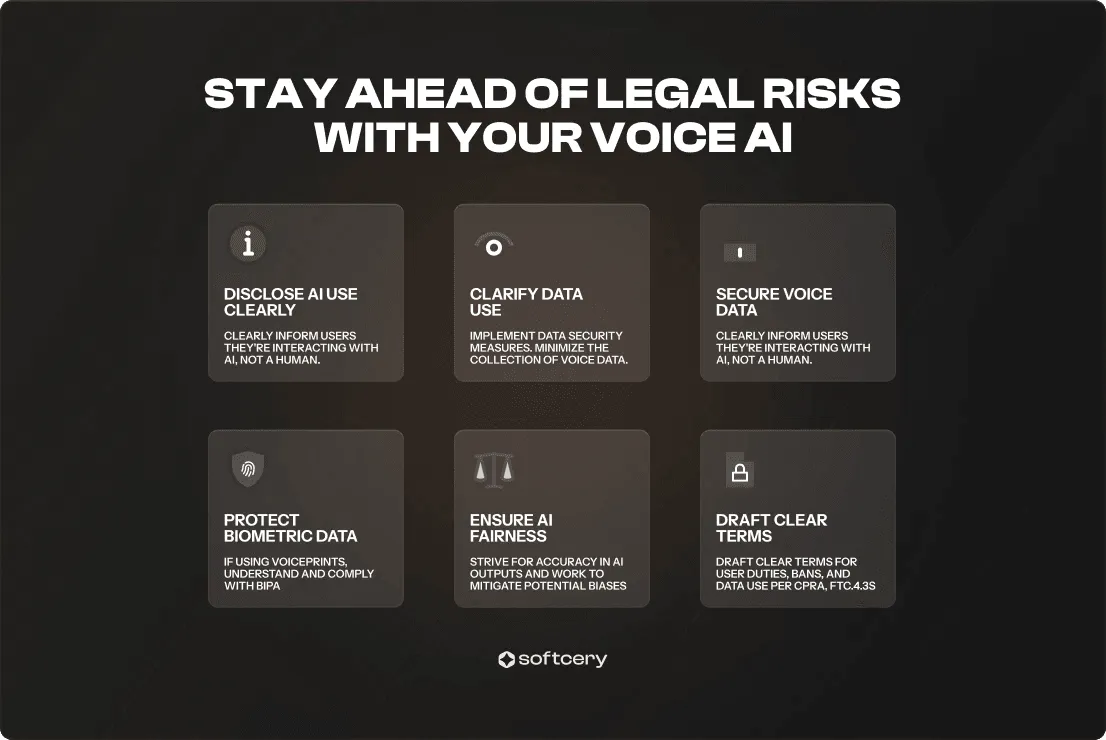
The Federal Trade Commission considers undisclosed or insecure data practices “unfair or deceptive.”
Minimum Action
- Publish a succinct privacy notice that explains – plainly – what you record, why, how long you keep it, and with whom you share it.
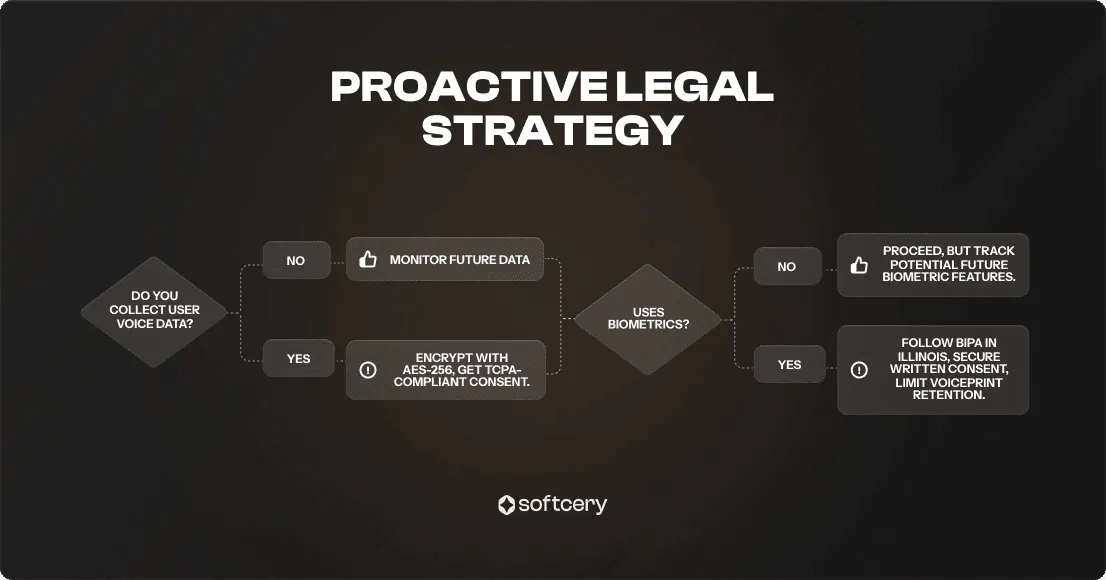
- Encrypt recordings in transit and at rest; restrict playback to staff with a defined business need.
Why It Matters
The FTC has authority to impose substantial fines, long-term consent decrees, and public reporting obligations. The pointed precedent for voice AI is FTC v. Rite Aid (Dec 19, 2023): a 5-year ban on facial recognition, mandatory deletion of biometric data and any derived models or algorithms, individualized written notice, and conspicuous in-store disclosure. The “model deletion” remedy — where the FTC compels destruction of trained models, not just the raw data — is the new template for biometric-AI cases. Amazon’s 2023 Alexa settlement ($25M, sweeping deletion controls) remains a useful baseline for child-data exposure.
What changed at the federal level (2024–2026)
- FTC Operation AI Comply (Sep 2024) — five enforcement cases targeting deceptive AI claims. DoNotPay settled for $193K (Jan 2025); Rytr received a final order banning AI-generated reviews (Dec 2024).
- December 2025: FTC reopened and set aside the Rytr order under the new administration, citing “undue burden on AI innovation.” Federal AI enforcement is materially softer in 2026 than in 2024. The pressure has shifted to the states.
- Trump EO 14179 (“Removing Barriers to American Leadership in AI”) signed Jan 23, 2025; Biden EO 14110 revoked Jan 20, 2025. America’s AI Action Plan released July 23, 2025 — deregulatory framework directing agencies to remove “onerous” rules.
- AISI → CAISI: the US AI Safety Institute was rebranded the Center for AI Standards and Innovation in June 2025, narrowing focus to national-security risks.
- NIST AI RMF 1.0 Generative AI Profile (NIST-AI-600-1) — published July 26, 2024. The substantive federal AI risk-management baseline; still in force.
2. Children’s Privacy (COPPA — Amended for Voiceprints)
Requirement
Collecting data from children under 13 demands parental consent and strict handling. The FTC’s amended COPPA rule (final April 22, 2025; effective June 23, 2025; compliance deadline April 22, 2026) expressly added biometric identifiers — voiceprints, faceprints, fingerprints, handprints, gait, iris/retina patterns, facial templates, and genetic data — to the definition of “personal information.” This is the load-bearing change for voice AI: capturing a child’s voiceprint is now categorically COPPA-regulated.
Minimum Action
- Block access to the service until a verifiable parent-consent flow is completed.
- Auto-delete children’s recordings when they are no longer required for the original purpose. The amended rule preserves a narrow audio-only exception: voice files used solely to fulfill a child’s request, with no other PI collected, must be deleted immediately after use.
- Retain auditable proof of consent and a written data-retention policy.
- Treat voiceprint enrollment as a separate, biometric-specific consent — not bundled into the general parental-consent flow.
Why It Matters
Regulators treat misuse of children’s data as an aggravating factor. With biometrics now explicitly in scope, the FTC can use the Rite Aid model-deletion template against voice-AI products serving minors. Penalties include civil fines and mandated product changes.
3. Automated Outreach (TCPA + FCC AI Voice Ruling)
Requirement
The Telephone Consumer Protection Act (TCPA) regulates outbound calls, texts, and voice broadcasts made using automated systems, including those utilizing AI-generated voices.
Clarification for Non-Marketing AI Calls
In February 2024, the FCC clarified that calls using AI-generated voices are “artificial or prerecorded voice” calls under the TCPA. Even non-marketing calls made using AI voice technology are subject to TCPA regulations. This ruling remains in force in 2026 — statutory damages unchanged at $500–$1,500 per call.
What’s changed since 2024
- July 2024 FCC NPRM proposed (a) a definition of “AI-generated call,” (b) specific consent for AI calls, and (c) an in-call AI disclosure. As of May 2026, the rule has not been finalized under the Trump-era FCC. Treat as “likely to land within 12 months.”
- One-to-one consent rule struck down. The 11th Circuit (Insurance Marketing Coalition v. FCC, Jan 24, 2025) vacated the FCC’s one-to-one consent rule; the FCC formally rescinded it Sep 2025. Pre-2024 “prior express written consent” standards remain in effect.
- Enforcement is real: Lingo Telecom settled with the FCC for $1 million (Aug 2024) for transmitting the AI-cloned “Biden” robocalls to New Hampshire voters. Steve Kramer (the operative) hit with a $6 million forfeiture (Sep 26, 2024) under the Truth in Caller ID Act, plus an NH criminal indictment for felony voter suppression.
Minimum Action
- Obtain Prior Express Written Consent: Before initiating any AI-generated voice calls, secure prior express written consent — regardless of the call’s purpose. The pre-2024 standard now governs in the absence of the vacated one-to-one rule.
- Provide Clear Identification: At the beginning of the call, clearly state the caller identity and disclose AI use. Multiple states (Utah for high-risk interactions; EU AI Act Article 50 for any EU-touching call) now require this regardless of FCC action.
- Offer Opt-Out Mechanism: An immediate, easy-to-use method to opt out of future calls; honor requests promptly.
- STIR/SHAKEN attestation: Ensure your telephony provider applies STIR/SHAKEN; the FCC’s Lingo settlement made compliant attestation a baseline expectation, not a nice-to-have.
Why It Matters
Statutory damages of $500–$1,500 per call compound fast — a 10,000-call campaign without consent is a $5M–$15M exposure before treble damages or class actions.
4. Biometric Voiceprints in Illinois (BIPA — Damages Model Rewritten)
Requirement
Illinois’ Biometric Information Privacy Act requires informed written consent and a public retention policy for any biometric identifier, including voiceprints.
What changed (the load-bearing fix)
The 2024-era compliance framing — “BIPA = $1,000 per negligent scan / $5,000 per intentional scan, multiplied across every recording” — is no longer accurate. Illinois enacted SB 2979 (Aug 2, 2024), which overrode Cothron v. White Castle: collecting or disclosing the same biometric identifier from the same person by the same method is now a single violation, not per-scan. SB 2979 also accepts electronic signatures for the written-release requirement.
The 7th Circuit confirmed retroactivity in April 2026, meaning even pending cases benefit from the single-violation rule. Statutory damages remain $1,000 (negligent) / $5,000 (intentional) per violation — but the multiplier collapses dramatically.
Minimum Action
- Present a separate written (or e-signed) consent document to Illinois users before capturing or analysing voiceprints.
- Publish a statement that sets retention limits and deletion procedures; follow it.
- Prohibit sale or other monetisation of biometric data.
Why It Matters
The class-action math is gentler than the 2024 environment suggested, but exposure is still material — and other states are watching. Texas SB 140 (effective Sep 1, 2025, a mini-TCPA under DTPA with $500–$1,500/violation), Tennessee ELVIS Act (effective July 1, 2024 — voice as a protected right of publicity against AI cloning), and Colorado/Utah biometric overlays mean Illinois is no longer the only meaningful jurisdiction.
5. State-Level Consumer Privacy and AI Disclosure (CPRA + ADMT + State AI Laws)
Requirement
California’s Consumer Privacy Rights Act – and similar statutes in other states – grants residents rights to access, delete, correct, and restrict use of their personal information. Penalties unchanged: up to $2,500/violation, $7,500 intentional or children’s data.
What’s new in California (the most active jurisdiction in 2026)
| Law | What it does | Effective |
|---|---|---|
| AB 2013 (GenAI Training Data Transparency) | Public disclosure of training datasets, copyrighted material, and PI | Jan 1, 2026 |
| SB 942 (CA AI Transparency Act) | Free AI-content detection tool; manifest + latent disclosures on AI audio/video/images | Aug 2, 2026 (delayed by AB 853 to align with EU AI Act) |
| AB 2602 (digital replicas in performance contracts) | Voids contract provisions allowing unauthorized digital replicas of performers | Jan 1, 2025 |
| AB 2655 (Deepfake Election Deception Act) | Large platforms must label/remove deceptive election deepfakes within 72hr (partially struck down in federal court Aug 2025 on Section 230/First Amendment grounds) | Jan 1, 2025 |
| CPPA ADMT Regulations | Pre-use notice, opt-out, appeal rights, risk assessments for AI used in “significant decisions” (finance, housing, employment, education, healthcare) | Finalized Sep 23, 2025; risk assessments by Jan 1, 2026; ADMT compliance Jan 1, 2027; attestations Apr 1, 2028 |
The CPPA ADMT regulations are the most operationally consequential change for voice AI deployed in California: any agent making or materially supporting a “significant decision” (loan eligibility calls, hiring screens, healthcare triage) now requires pre-use notice, opt-out, appeal, and a documented risk assessment.
Other states that matter
- Colorado AI Act (SB 24-205) — effective date pushed from Feb 1 → June 30, 2026 by SB 25B-004. Currently under litigation: X.AI LLC v. Weiser (filed Apr 9, 2026; DOJ intervened Apr 24); an Apr 27, 2026 court order temporarily suspends state-initiated enforcement. Colorado SB 26-189 (replacement framework) passed both chambers May 7–9, 2026, status awaiting governor action as of this writing.
- Texas TRAIGA / HB 149 — signed June 22, 2025; effective Jan 1, 2026. AG-exclusive enforcement, 60-day cure period. Categorical bans on AI for behavioral manipulation, unlawful deepfakes, and constitutional-rights infringement.
- Utah AI Policy Act (UAIPA) — 2025 amendments (SB 226, SB 332, HB 452, SB 271, eff. May 7, 2025) narrowed proactive disclosure to “high-risk AI interactions” (health, finance, biometric, significant advice). Mental health chatbots: disclosure before access, every 7 days, and on demand. Penalties: $2,500/violation (DCP) or $5,000 (AG civil).
- Tennessee ELVIS Act — first US statute making “voice” a protected right of publicity against AI cloning. Effective July 1, 2024.
- Connecticut SB 5 (AI Responsibility & Transparency Act) — passed both chambers ~May 1, 2026. Not yet signed by Governor Lamont as of May 14, 2026 (publicly committed to sign). Effective dates if signed: most provisions Oct 1, 2026; AEDT deployer obligations Oct 1, 2027; frontier-model and companion-chatbot provisions Jan 1, 2027.
- Virginia HB 2094 (would have been the second comprehensive state AI law) — vetoed by Governor Youngkin Mar 24, 2025. No override.
- NYC Local Law 144 — bias audit for AEDTs (automated employment-decision tools), in force since July 5, 2023. Penalties $500–$1,500/day; each day a separate violation.
- Michigan HB 4047/4048 (Aug 2025) — criminalizes nonconsensual intimate AI deepfakes.
- NCSL tracked 146 deepfake bills introduced across states in 2025 alone — the landscape shifts weekly.
Federal AI moratorium attempt — defeated
The House-passed One Big Beautiful Bill Act included a 10-year moratorium on state AI enforcement. The Senate stripped it out 99–1 on July 1, 2025 (Tillis the lone “no”). The Act was signed without the moratorium July 4, 2025. State laws remain in full force — and absent further federal action, the state mosaic is the regulatory landscape.
Minimum Action
- Offer a visible mechanism for California users to exercise CPRA rights, including “Do Not Sell/Share” options.
- Build a process to locate and delete individual voice records upon request.
- Maintain an internal log showing how requests were handled.
- For any agent influencing a “significant decision” affecting California residents, add ADMT pre-use notice + opt-out + appeal.
- Maintain a training-data inventory sufficient for AB 2013 disclosures.
6. Sector-Specific Obligations
| Context | Rule | Minimal Safeguard |
|---|---|---|
| Healthcare | HIPAA | Encrypt recordings, sign a Business Associate Agreement, limit workforce access, log every playback. |
| Financial services | GLBA Safeguards Rule | Adopt a written security programme and vendor-risk audit; publish an annual privacy notice. |
| Payment processing | PCI DSS (industry standard) | Avoid handling card numbers; if unavoidable, route transactions through a certified gateway and tokenise data. |
| Lending / consumer finance | CFPB UDAAP, ECOA, FCRA | The Bureau has named chatbots as a fair-lending compliance risk; under the current administration it is publishing AI compliance plans (Sep 2025) rather than bringing major new actions. |
| Employment / hiring | EEOC (Title VII still applies); NYC LL 144 | EEOC removed its May 2023 AI hiring guidance from its website on Jan 27, 2025 — but Title VII liability did not change. Mobley v. Workday (N.D. Cal., July 2024, collective certified May 2025) lets disparate-impact claims proceed against the AI vendor itself, not just the employer. |
Failure in any of these sectors invites regulatory penalties and immediate loss of B2B contracts.
HIPAA Security Rule — major update
On Jan 6, 2025, HHS published the first significant HIPAA Security Rule NPRM since 2003 (comment period closed Mar 7, 2025). It targets encryption, MFA, asset inventories, and AI-specific risk analysis. OCR confirmed in March 2025 that Phase 3 HIPAA compliance audits are underway against ~50 covered entities and business associates.
BAAs with AI vendors must now address:
- Prohibition on using PHI to train or improve models without explicit authorization
- Sub-processor disclosure (every STT/LLM/TTS vendor in the chain)
- 24–48 hour breach notification
- Data deletion at termination — including derived models
- Audit logs and encryption attestation
7. Accessibility (ADA and §508)
Provide alternative input and output channels – keypad, text chat, captions – so users with speech or hearing impairments can interact. Inaccessibility lawsuits are routine and expensive to defend. A 2024 cautionary example: Wendy’s AI drive-thru cutting off speakers with stutters or pauses longer than 0.5 s drew explicit ADA-risk concerns. Voice agents that fail on accent or disfluency are not just bad UX — they are legal exposure.
8. Bot Identification (California BOT Act)
If the agent promotes goods or services to the public in California, it must disclose its non-human nature at the start of the interaction (“I am an automated virtual assistant”). The requirement is simple and the risk of omission unnecessary.
9. Federal Deepfake / Voice-Clone Statutes
Two new federal pieces relevant to anyone building voice-clone products:
- TAKE IT DOWN Act (S.146) — signed by Trump May 19, 2025. Criminalizes knowing publication of non-consensual intimate imagery, including AI-generated deepfakes. Platforms must build a notice-and-takedown system by May 19, 2026 with 48-hour removal windows. FTC enforces. Penalties up to 2 years (adult victims) or 3 years (minor victims).
- NO FAKES Act (S.1367 / H.R.2794) — reintroduced April 2025. Federal property right against unauthorized AI digital replicas of voice and likeness, with platform notice-and-takedown obligations. Bipartisan; supported by SAG-AFTRA, RIAA, OpenAI, Disney, Google. Not yet enacted as of May 2026 but treat as a likely federal landing within 12 months.
10. EU AI Act — Extraterritorial Note for US Founders
You are likely in scope if your outputs are “used in” or “produce effects” in the EU — even via a downstream reseller. Key dates:
- Feb 2, 2025: Prohibited AI practices ban in force.
- Aug 2, 2025: GPAI obligations live. Non-EU providers must appoint an EU authorized representative.
- Aug 2, 2026: General application date. Article 50 requires callers be told at the start of any AI-voice interaction that they’re speaking with AI, in their language, with a non-audio alternative for accessibility.
- Penalty tiers: up to €35M or 7% of global turnover for Article 5 prohibited practices; up to €15M or 3% for most other obligations including Article 50 transparency violations (the tier that applies to voice-AI disclosure); up to €7.5M or 1% for supplying incorrect info to authorities.
Five-Step Compliance Framework (Updated for 2026)
1. Inventory and Classify Every AI System
Maintain a register of every AI system, its training-data provenance (CA AB 2013 disclosure), its risk tier (Colorado AI Act high-risk / EU AI Act high-risk), and any biometric identifiers processed (voiceprints are now expressly PI under amended COPPA, CCPA, BIPA).
2. Consolidate Consent and Disclosure Workflows
One interface should gather: (a) TCPA prior-express-written-consent for AI marketing calls; (b) in-call AI disclosure where required (Utah high-risk interactions, EU AI Act Article 50 for EU exposure, pending FCC NPRM); (c) separate recording consent; (d) BIPA written release before voiceprint enrollment; (e) ADMT pre-use notice + opt-out for any “significant decision.” Store timestamped proof.
3. Minimize Data and Purge on Schedule
Retain audio no longer than 30–60 days unless a statute (e.g., HIPAA) compels more. The amended COPPA audio-only exception requires immediate deletion. Contractually prohibit vendors from using your data to train or improve models without explicit authorization (the HIPAA BAA pattern, now extended).
4. Apply Technical Safeguards That Match the New Remedies
- AES-256 encryption at rest, TLS 1.2+ in transit
- Role-based access control + MFA for anyone who can replay recordings
- Immutable audit logs
- STIR/SHAKEN attestation for outbound calling
- Watermarking / provenance for synthetic media (CA SB 942 manifests + latent)
- Tested deletion of data AND derived models (the Rite Aid remedy template — the FTC now compels destruction of trained models, not just raw data)
5. Governance and Assessments
- Annual cybersecurity audit + ADMT risk assessment (CPPA, effective Jan 1, 2026)
- Independent bias audit if used in hiring (NYC LL 144)
- HIPAA Phase 3 audit readiness if in healthcare
- EU AI Act conformity assessment if any EU exposure
- Incident-reporting playbook aligned to NIST AI RMF GAI Profile
A four-hour quarterly exercise is no longer sufficient for anyone processing biometrics or making significant decisions. Plan for documented quarterly reviews and at least annual independent assessment.
Regulatory Horizon (Next 12 Months)
| Development | Status | Practical Preparation |
|---|---|---|
| Colorado AI Act + replacement bill SB 26-189 | Enforcement stayed by Apr 27, 2026 court order; SB 26-189 awaiting governor signature | Maintain training-data and error-rate documentation; track the X.AI litigation and SB 26-189 outcome |
| Connecticut SB 5 | Passed both chambers May 2026; awaiting Lamont signature | If signed, most provisions effective Oct 1, 2026; AEDT deployer obligations Oct 1, 2027 |
| FCC AI calls/texts NPRM (July 2024) | Not finalized; pending under Trump-era FCC | Plan for in-call AI disclosure becoming federal rule within 12 months |
| NO FAKES Act (federal voice/likeness replica) | Reintroduced April 2025; Senate hearings May 2025 | Build notice-and-takedown and consent-of-likeness infrastructure now if your product clones voices |
| TAKE IT DOWN Act compliance deadline | Platform deadline May 19, 2026 for notice-and-takedown infra | If you host user-generated AI content, the 48-hour removal SLA is already binding |
| California ADMT compliance dates | Risk assessments Jan 1, 2026; ADMT compliance Jan 1, 2027; attestations Apr 1, 2028 | Begin risk-assessment documentation for any agent influencing a “significant decision” affecting CA residents |
| EU AI Act Article 50 | General application Aug 2, 2026 | Implement start-of-call AI disclosure with non-audio alternative if any EU exposure |
When to Defer
- PCI DSS – irrelevant if the agent never collects card numbers.
- ISO/IEC AI certifications – valuable for enterprise sales, not legally required.
- State privacy statutes covering jurisdictions with no current users – adopt as soon as market expansion begins.
Implementation Shortcuts for Resource-Constrained Teams
- Telephony compliance – select a platform (Twilio, Amazon Connect) that embeds TCPA consent capture and call-recording disclosures.
- Privacy requests – outsource CPRA/CCPA workflows to a privacy-operations service (Transcend, Osano) rather than building in-house tooling.
- Access control – deploy an off-the-shelf identity and access-management layer to avoid bespoke permission logic.
Conclusion
The 2024 framing — five federal anchors plus periodic auditing — no longer covers the field. The federal layer has thinned (revoked EO, scaled-back FTC enforcement, unfinalized FCC AI rule); states have filled the gap (California ADMT, Texas TRAIGA, Tennessee ELVIS, Colorado AI Act + replacement, Utah UAIPA, NYC LL 144, Illinois BIPA post-SB 2979); biometric identifiers are now expressly regulated under COPPA; and remedies have grown teeth — the FTC can compel deletion of trained models, not just raw data.
For most early-stage voice-AI founders, the practical reality is: federal floor + 50-state mosaic. Get the federal floor right (TCPA consent, COPPA voiceprint handling, FTC §5 transparency, HIPAA where it applies, TAKE IT DOWN compliance), then layer state-specific obligations onto the states where your users actually live. Run an annual training-data and risk-assessment exercise (CA AB 2013, CPPA ADMT). Build the technical safeguards that map to the new remedies (data deletion + model deletion + STIR/SHAKEN + watermarking). And treat NO FAKES Act and FCC AI rule finalization as imminent.
Compliance is no longer a one-page checklist. But it’s still a manageable discipline — provided you read the post-2024 picture, not the pre-2024 one.