Proximo AI: From Broken Prototype to Conference Demo in 4 Weeks
Most AI conversations last minutes. Proximo's last weeks – sometimes months.
That's the difference between a chatbot and a coach. A chatbot answers questions. A coach guides someone through a structured journey – remembering everything they've shared, following a methodology, synthesizing insights across dozens of interactions. The AI needs to feel like a thoughtful conversation, not a form to fill out.
Building this is harder than it sounds. The system has to track where someone is in a multi-phase process. What they've revealed about themselves. How that information connects across sessions. It needs to stay on methodology while adapting to each person – and remain engaging enough that they return, week after week.
The complexity compounds quickly. Edge cases multiply. What works for a single conversation breaks when stretched across a months-long journey.
Kevin Nguyen and Dan Savage learned this the hard way.
The Request
Kevin and Dan are veterans. Dan had built a coaching methodology for career transitions – years of research, refined through hundreds of real conversations. Structured guidance through a multi-phase process, not quick advice. Kevin saw how to scale it: AI that could deliver the same coaching to thousands, the way Dan would deliver it one-on-one.
They'd already tried once. The prototype was hardcoded – a sophisticated quiz trying to behave like a coach. It couldn't handle the complexity: too many phases, too many modules, too much to track and synthesize while staying on methodology and remaining engaging. The approach didn't scale.
When they came to us, they had four weeks until a conference demo at NASWA – the National Association of State Workforce Agencies. The timeline seemed too tight for the scope.
The timeline was fixed. The scope wasn't.
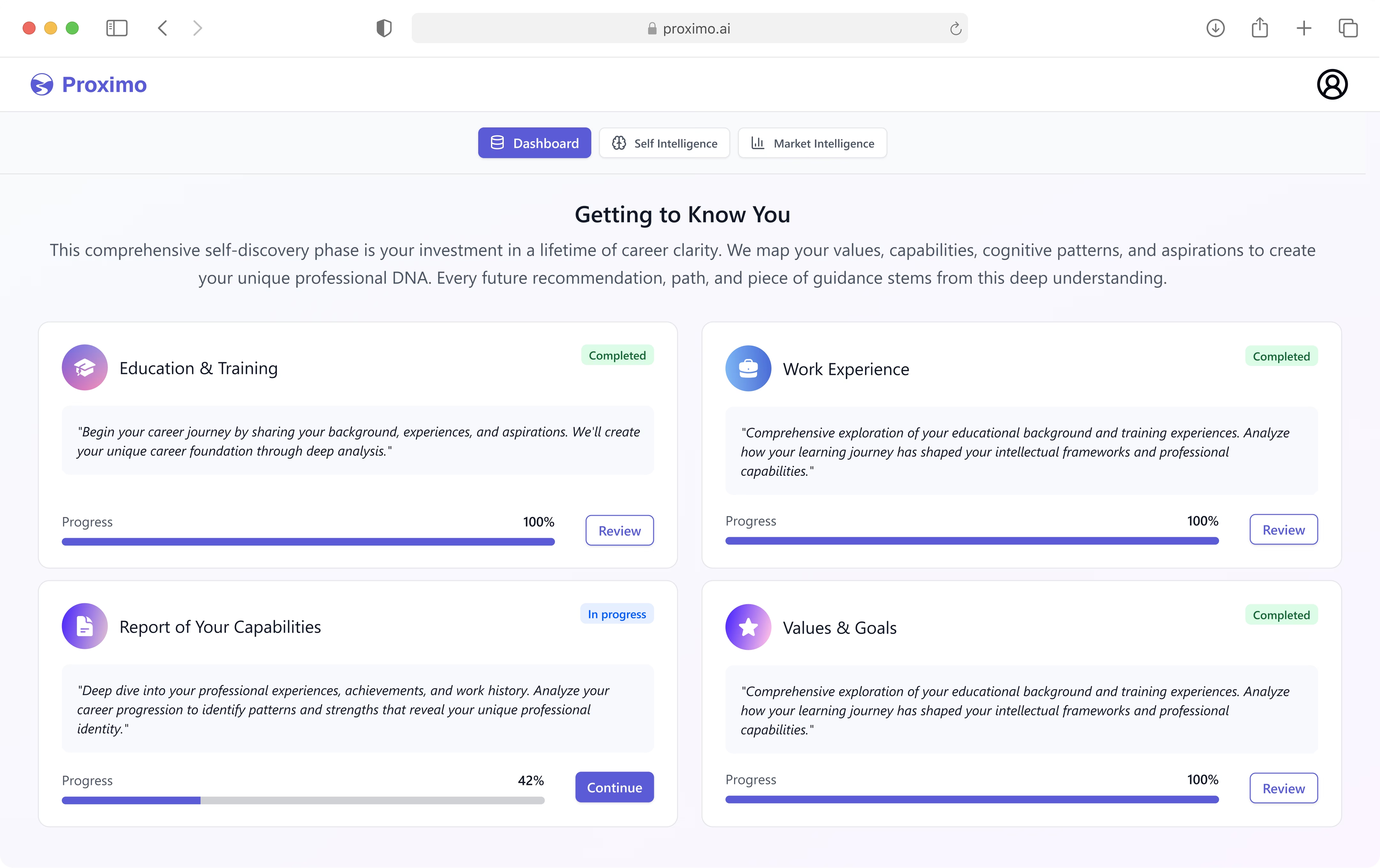
Why Long-Form Coaching Is Different
Before figuring out what to cut, we needed to understand what made this problem genuinely hard.
Most AI applications optimize for single interactions. Ask a question, get an answer. Start fresh next time. Career coaching doesn't work that way.
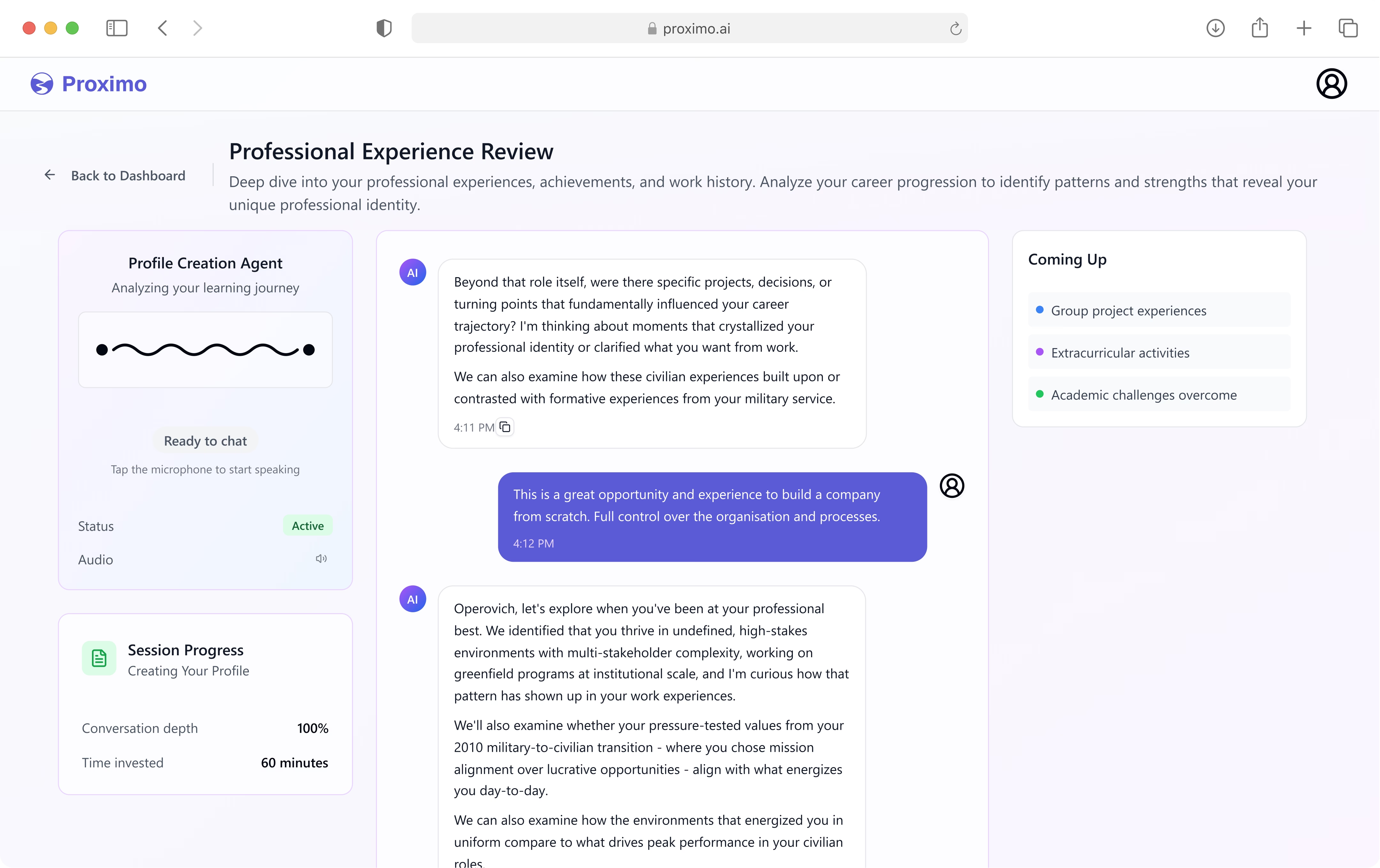
Memory has to be structural, not just semantic. The system can't just remember what users said – it needs to understand where that information fits in the coaching methodology. A user's answer about their military experience in phase one becomes context for questions about transferable skills in phase three. Miss that connection, and the coaching falls apart.
Each phase builds on the last. Career coaching follows a methodology for a reason. Self-discovery before goal-setting. Goal-setting before action planning. Skip a phase or get the sequence wrong, and the insights don't land. The AI has to guide users through a specific arc while making it feel natural, not forced.
Engagement compounds or collapses. In a single-session chatbot, a mediocre response costs you one interaction. In a weeks-long coaching journey, a mediocre response in week one means the user doesn't come back for week two. The system has to earn continued engagement, session after session.
The methodology is the product. Dan's coaching approach wasn't just content to feed an AI – it was the core intellectual property. The system had to execute that methodology faithfully, not approximate it. Getting 80% of the coaching right wasn't good enough.
These constraints shaped every technical decision.
The Approach
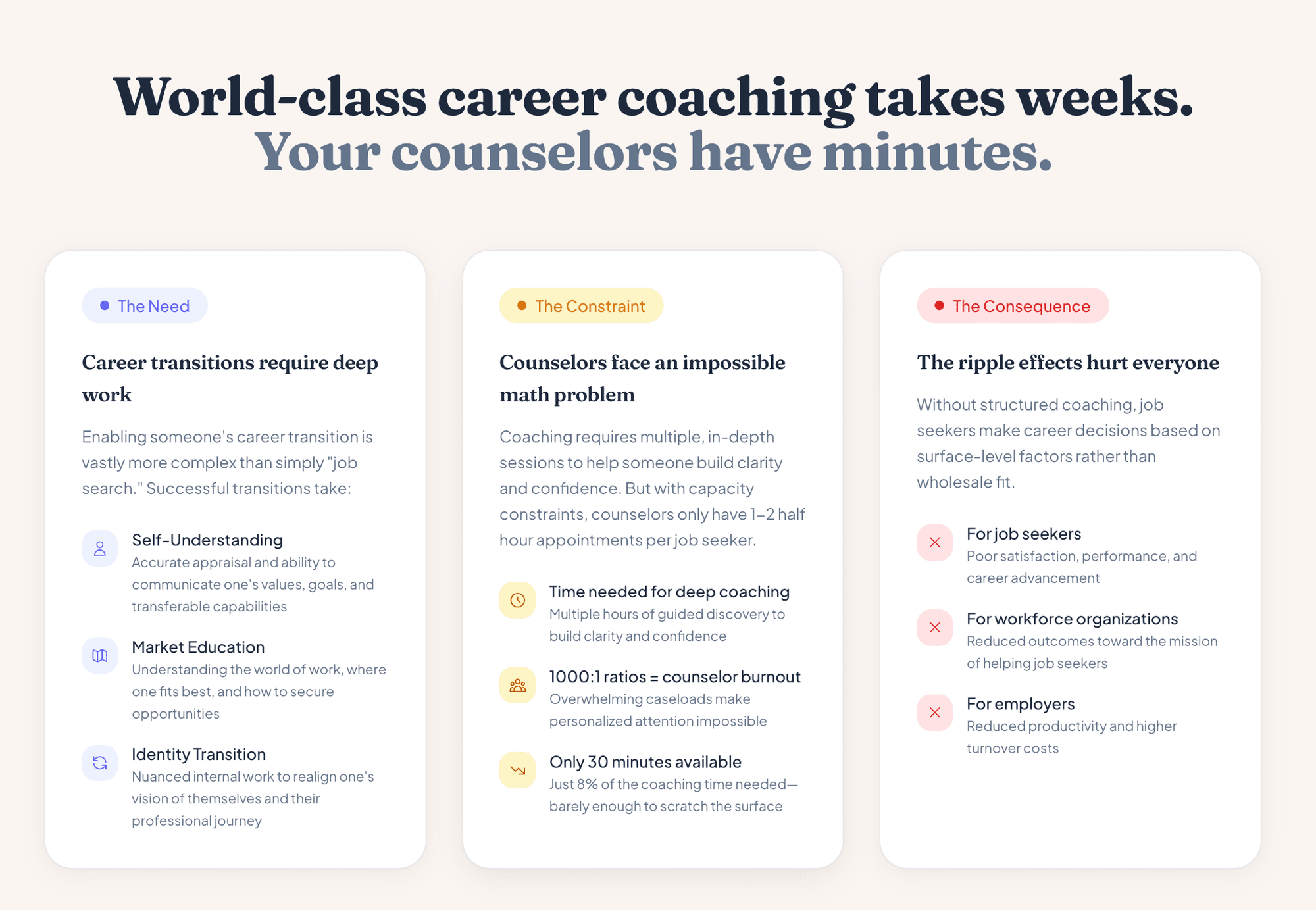
The original vision had over a dozen phases. For the demo, we focused on eight – enough to demonstrate the full arc of the coaching experience without building everything at once.
But reducing scope alone wouldn't have been enough. When content is embedded in code, every change requires a developer. We needed an architecture where Kevin and Dan could shape the coaching experience directly.
Separating structure from content. The system handled navigation, memory, and conversation flow. The methodology – questions, prompts, phase transitions – lived outside the code, in a format Kevin and Dan could edit themselves. Dan could refine a question without waiting for a code change. Kevin could reorder modules based on user feedback.
Phases and modules as building blocks. Each phase represented a stage in the coaching journey. Each module within a phase handled a specific interaction – a question to ask, information to gather, an insight to synthesize. The system tracked where each user was, what they'd shared, and what came next. Kevin and Dan could restructure the entire coaching flow without touching the underlying system.
Controlled AI, not autonomous AI. The AI didn't run the conversation freestyle. It operated within the structure Kevin and Dan defined – asking the questions they wrote, following the transitions they specified, synthesizing insights at the points they chose. This kept the methodology intact while still delivering a conversational experience.
A web interface built for the journey. Users needed to pick up where they left off, see their progress, and engage in conversations that felt natural. We built a chat interface designed for long-form coaching – not a single Q&A session, but an ongoing relationship with the AI coach.
We built the framework. They owned the methodology.
The Validation Problem
A real user takes weeks to complete Proximo's coaching journey. But we couldn't wait weeks to know if a change broke something.
Any edit to the methodology – a reworded question, a reordered module, a refined prompt – could affect conversations downstream. The system had to remember what users shared earlier and use it later. A small change in phase two might surface as a problem in phase six.
Manual testing wasn't practical. We needed a way to validate the full journey in hours, not weeks.
We built automated testing that simulated complete user journeys – different personas, different responses, different paths through the coaching process. When something broke, we caught it before users did. This became the foundation of stability as the system evolved.
Four Weeks Later
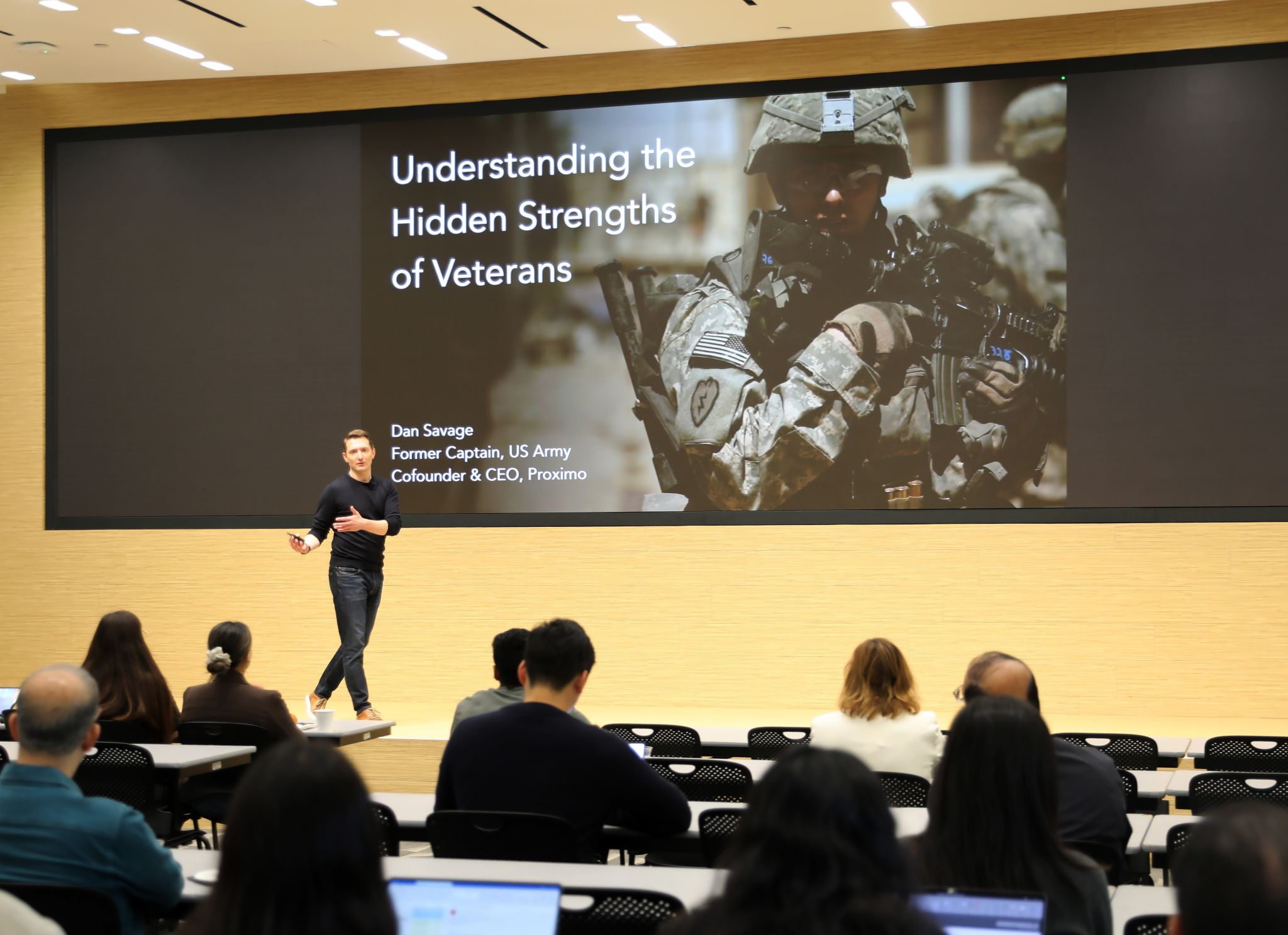
The demo at NASWA worked. Kevin and Dan collected contacts, fielded questions about implementation, and validated that the concept resonated with their target audience.
More importantly, they had a foundation to build on. Not a throwaway prototype, but a system designed to evolve.
The partnership continued. Voice capabilities came next – narration and transcription that made the coaching feel more natural. The platform expanded beyond the initial eight phases. Kevin and Dan kept refining the methodology while we extended the system's capabilities.
The architecture we'd built in those first four weeks held up through a full year of iteration, growth, and real users.
How We Worked Together
Building an AI coaching platform isn't purely a technical problem. The coaching methodology had to drive the product decisions. That meant understanding what Dan was trying to achieve with each phase, why certain questions mattered, how insights should build on each other.
"Softcery's approach is exceptionally thoughtful – they consider the complete business context, not just the immediate technical requirements."
We were also direct about what AI could and couldn't do. When an idea wasn't feasible, we said so. When there were tradeoffs, we explained them. Kevin and Dan made better product decisions because they understood the constraints.
"Their transparency about AI capabilities has been crucial for making informed strategic decisions about our product."
– Kevin Nguyen, Co-Founder, Proximo
Where It Stands
Proximo is live, guiding people through career transitions. What started as an eight-phase demo has grown into a full coaching platform – more phases, voice interaction, deeper insights, a richer experience overall.
The architecture held up. Through a year of iteration, user feedback, new features, and business pivots, the foundation we built in those first four weeks kept working. Kevin and Dan reshaped the coaching methodology dozens of times. The system handled every change.
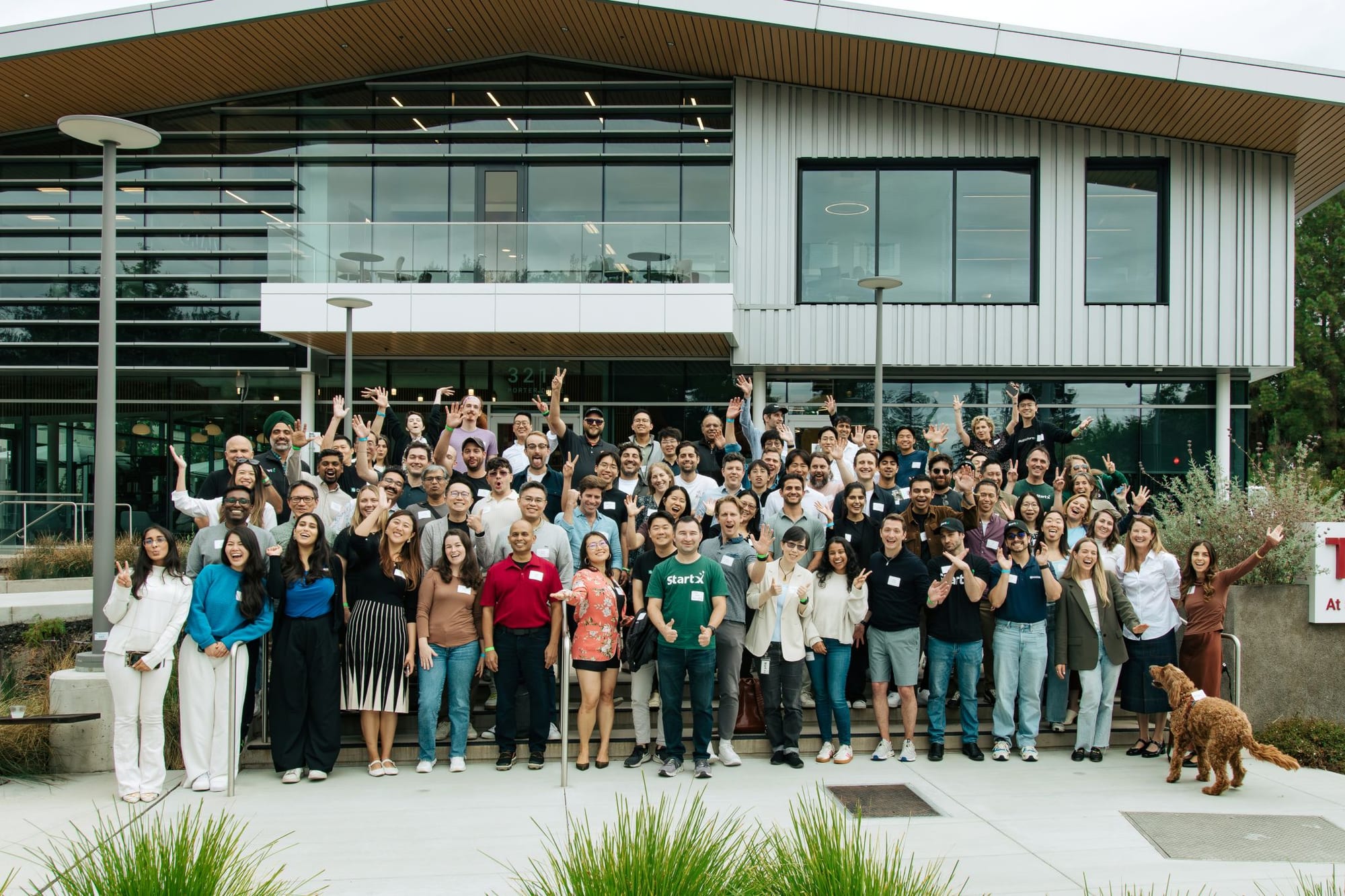
Proximo was accepted into StartX. Enterprise customers followed. The platform that almost didn't get built in time for a conference demo is now serving real users making real career decisions.