Financial Advisory AI: A Statement of Advice in 2 Minutes
Financial advisors don't get paid to write documents. They get paid to understand people, build trust, and guide decisions that shape retirements, protect families, and grow wealth.
A New Zealand financial advisory firm came to us because their advisors were trapped doing exactly that – spending 4-6 hours manually assembling each Statement of Advice. Intake forms, meeting notes, risk assessments, tax calculations, investment comparisons, cashflow projections. All compiled by hand into 15-20 page documents that must be accurate, compliant, and personalized.
The math doesn't work. An advisor handling 10 new customers monthly spends 40-60 hours just on document creation. That's a full week consumed by formatting and writing – not advising.
The Problem
This manual process creates three problems:
Time drain on high-value work. Advisors spend more hours on document assembly than on customer relationships and strategic planning. Every new customer means another half-day lost to manual compilation.
Inconsistency across advisors. Different writing styles and document structures make quality control difficult. Review cycles extend as managers check each SOA for compliance and consistency.
Scaling limitations. Advisory firms can't grow customer capacity without hiring additional advisors or accepting longer turnaround times. Document creation becomes the bottleneck in the entire advisory process.
The Solution
An AI-powered document generation platform transforms raw intake data into complete, professionally formatted SOA documents in under 2 minutes.
The system works in three stages:
Data extraction. The platform ingests structured information from intake forms and advisor meeting notes. Type-safe data models validate all inputs – customer details, properties, retirement accounts, insurance policies – before processing begins.
Parallel AI generation. The system generates 14 document sections simultaneously. Narrative sections – risk assessments, recommendations – use domain-specific prompts. Financial sections – tax calculations, cashflow projections – use deterministic logic with jurisdiction-specific rules.
Document assembly. Generated content flows into professionally designed PowerPoint templates with conditional rendering based on customer circumstances. PPTX output lets advisors review and refine before delivery – adjusting wording, adding context, or customizing recommendations.
How We Built It
-
Hybrid Generation Architecture – LLM-based generation for subjective content (risk assessment, recommendations) combined with in-code calculations for financial modeling (tax rates, cashflow, projections)
-
Structured Prompt Engineering – Domain-specific prompts for each SOA section ensure consistent, compliant output with personalized direct speech
-
Template-Based Assembly – Dynamic content insertion into professionally designed templates with conditional page rendering based on individual profiles
-
Editable Output Format – PPTX delivery enables advisors to make adjustments before finalizing, maintaining human oversight while eliminating repetitive document creation
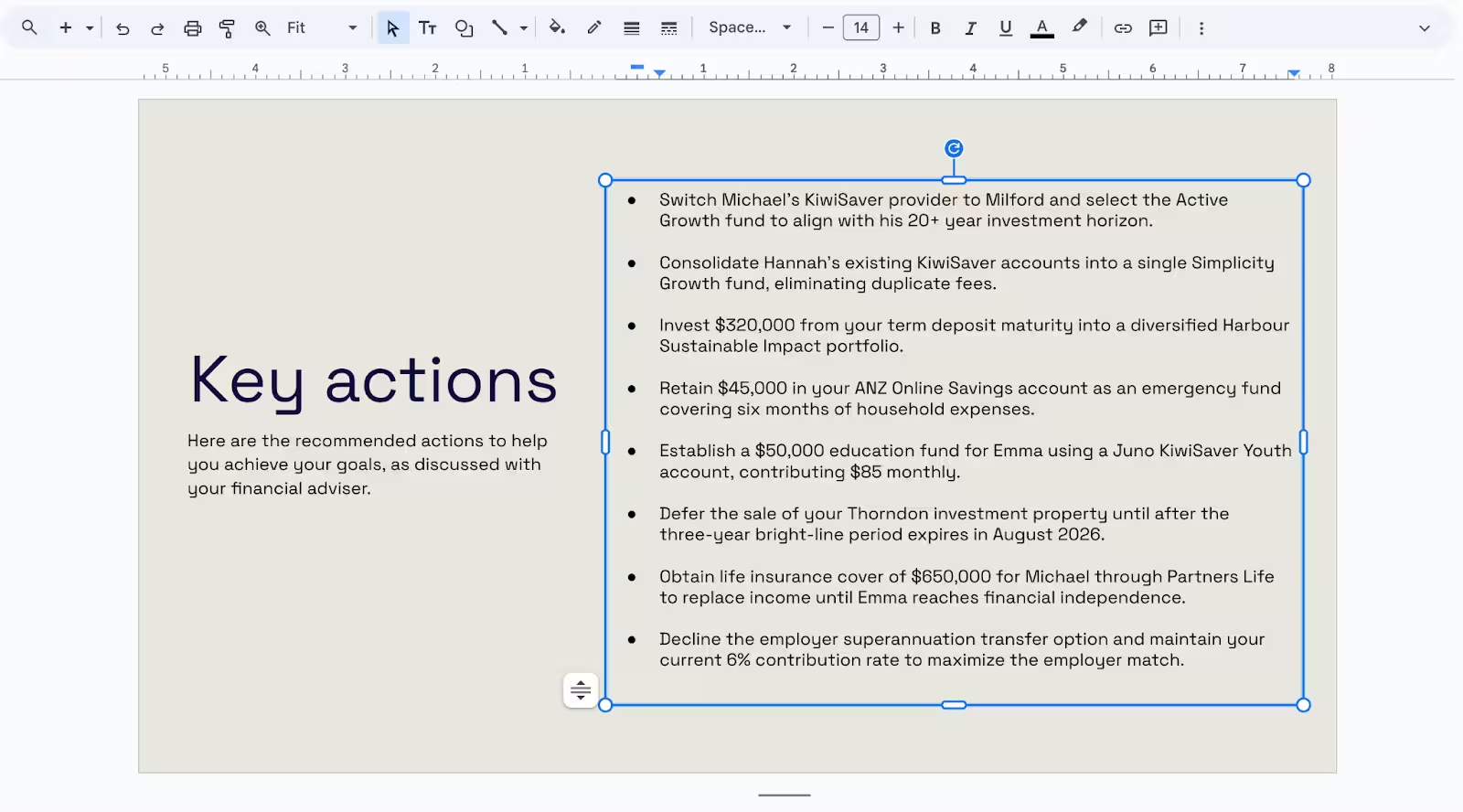
Below: a Key Actions slide generated from sample intake data. The advisor can adjust any recommendation before sending.
Technical Approach
The platform combines large language model flexibility with deterministic financial calculation reliability. Python's ThreadPoolExecutor runs the 14 sections in parallel. Generating them one after another took 15+ minutes; in parallel it lands under 2.
Separating Narrative from Numbers
The system separates subjective narrative from objective calculation:
- Narrative sections – Risk assessments and personalized recommendations leverage Google's Gemini 2.5 Flash
- Financial sections – Tax rates, cashflow projections, and balance sheets compute through type-safe Python data models
- Data extraction – 330+ line JSON schema parses intake forms into 12 domain models (Client, Property, RetirementAccount, InsurancePolicy, Budget) with built-in validation
- Domain rules – Jurisdiction-specific tax brackets, retirement account calculations, cashflow distribution, conditional rendering based on profile data
Section-Specific Prompts
A single generic prompt like "generate a complete SOA document" produces inconsistent results. Tone varies between sections. Domain requirements get missed. Output becomes unpredictable.
14 purpose-built prompts solve this. Each enforces exact structure, tone, and domain rules. Failures isolate to individual sections rather than breaking entire documents.
Document Rendering
The final stage injects generated content into professionally designed PowerPoint templates – AI-generated text, calculated figures, charts, and tables.
Why PPTX instead of PDF? Advisors need to review and adjust recommendations based on nuances the system couldn't capture. An editable format maintains human oversight without sacrificing automation benefits.
What It Does
| Metric | Result |
|---|---|
| Manual assembly, per the firm | 4-6 hours per document |
| Generation time | under 2 minutes per document |
| Sections generated | 14 per document, in parallel |
| Calculation | deterministic, computed in code |
Feed in intake data and meeting notes, get a full Statement of Advice back. Structure comes from the templates, so every document lands in the same shape, to the same standard, whoever started it.
Jurisdiction-specific work runs in code, not in the model: tax bracket calculations, retirement account projections, cashflow distribution. The advisor opens an editable deck, adjusts the wording to the customer in front of them, and sends.